Modern machine learning architectures frequently rely on deep representation learning coupled with non-parametric classifiers to solve complex visual recognition and retrieval tasks, particularly in domains constrained by sparse training data. Standard deep learning pipelines often couple feature extraction directly with parametric softmax classifiers, making them brittle when applied to small medical or domain-specific datasets where data augmentation introduces unacceptable clinical distortions. This architectural breakdown analyzes representation learning with local-margin triplet loss and sampling strategies for K-nearest-neighbor image classification, exploring how bridging metric learning objectives with K-Nearest-Neighbor classification creates robust, transferable feature spaces that excel under constrained data regimes.
- What is High-Performance Vector Search & Graph-Based Retrieval Systems?
- Architectural Foundations of Local-Margin Triplet Learning
- Sampling Strategies: Mining Local Positives and Negatives
- Comparative Architectural Analysis
- Empirical Performance & Domain Validation
- Critical Evaluation, Limitations, and Production Trade-Offs
- Adoption Guide: When to Adopt vs When to Pass
- Bridging Triplet Loss and K-NN Classification: Directly integrates the K-Nearest-Neighbor hyper-parameter into the loss formulation and sampling strategy, ensuring the learned metric space aligns natively with downstream non-parametric classification.
- Local-Margin Optimization: Replaces global margin assumptions with adaptive local margins, mitigating common collapse modes in deep metric learning and stabilizing convergence across diverse data distributions.
- Robustness Under Data Constraints: Outperforms traditional end-to-end softmax classifiers and standard triplet configurations in data-scarce domains like medical imaging where heavy data augmentation is clinically invalid.
- Preservation of Transferable Features: Maintains high representation transferability for related downstream tasks without requiring end-to-end fine-tuning of the classification head.
What is High-Performance Vector Search & Graph-Based Retrieval Systems?
High-Performance Vector Search & Graph-Based Retrieval Systems is a computational framework for indexing, searching, and classifying high-dimensional embedding spaces by constructing topological neighborhood graphs that map structural similarities, enabling sub-millisecond retrieval, robust nearest-neighbor clustering, and semantic search operations across massive enterprise datasets.
To understand the core innovation behind neighborhood-aware representation learning, we must examine the limitations of traditional deep classification pipelines. Standard architectures project raw input images through convolutional or transformer backbones into a latent space, immediately terminating at a linear softmax layer. While effective for massive datasets like ImageNet, this parametric coupling forces the feature extractor to optimize exclusively for linear separability under the training distribution. When deployed in specialized verticals—such as radiation oncology, rare pathology, or industrial anomaly detection—sample sizes plummet, and heavy data augmentations (e.g., random rotations, shears, or color inversions) can corrupt critical semantic features.
Metric learning frameworks, specifically triplet networks, offer an alternative by training models to group similar instances and repel dissimilar ones within an embedding space. However, traditional triplet loss formulations suffer from severe heuristic bottlenecks: choosing global margins is notoriously difficult, random or semi-hard negative mining is computationally expensive and unstable, and the learned space is rarely optimized for downstream non-parametric classifiers like K-Nearest-Neighbors. The research establishes a unified theoretical and empirical foundation that explicitly couples the K-NN hyper-parameter directly into the loss calculation and neighborhood sampling strategy.
Architectural Foundations of Local-Margin Triplet Learning
Local-margin triplet learning is an advanced metric optimization framework that dynamically adjusts intra-class compactness and inter-class separation based on the local density of K-NN neighborhoods, replacing static global margins with adaptive distance thresholds that stabilize gradient updates during deep network training.
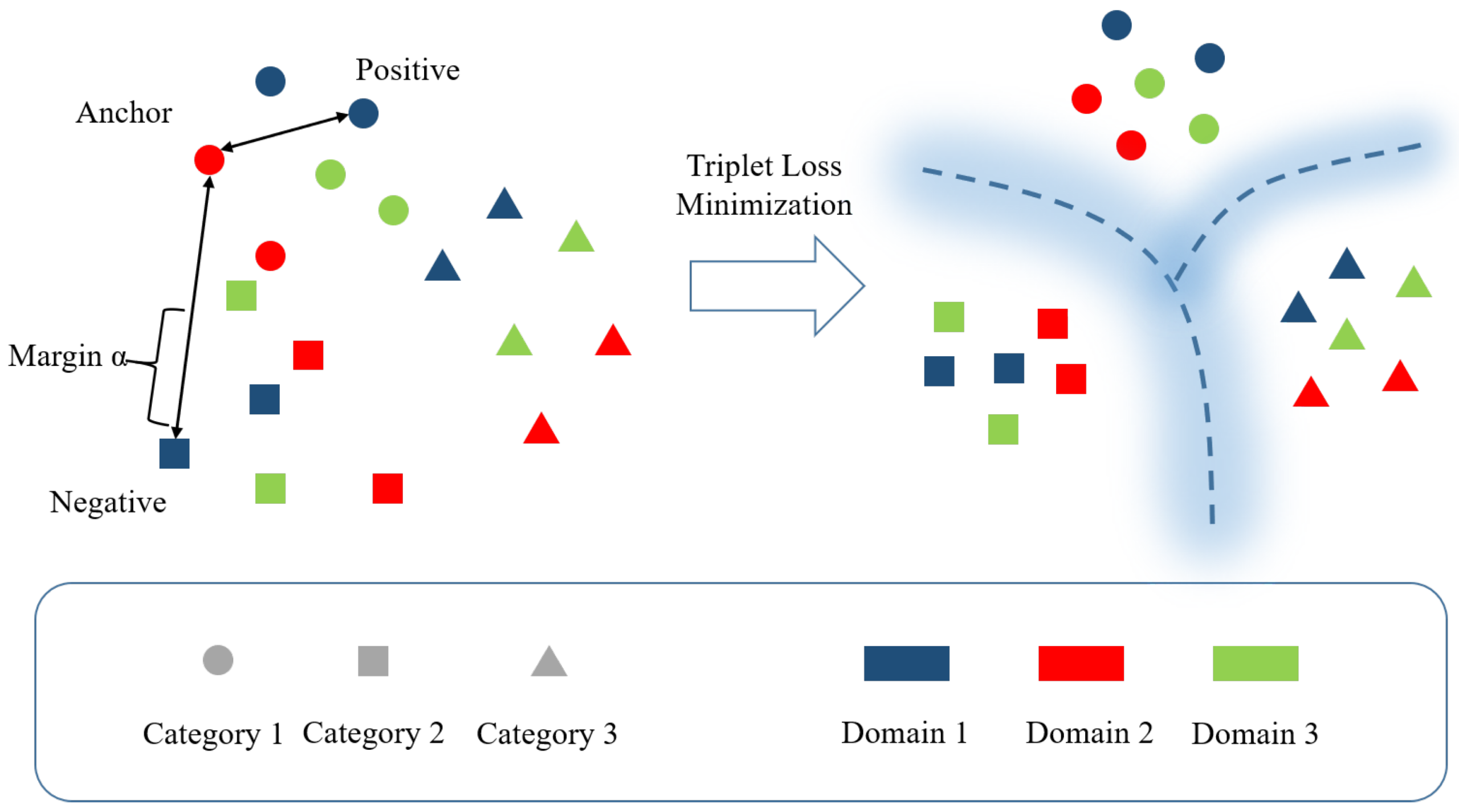
In standard metric learning, a triplet consists of an anchor sample, a positive sample of the same class, and a negative sample of a different class. The objective is to ensure that the squared distance between the anchor and the positive, plus a margin, is less than the squared distance between the anchor and the negative. Mathematically, this forces all negative samples beyond a fixed global boundary. In practice, this rigid constraint causes gradient saturation, slow convergence, and catastrophic forgetting, as many negatives are already easy or outliers force excessive distortion.
The local-margin approach addresses this by defining neighborhoods around each sample that reflect the expected K-NN classification dynamics. Instead of forcing all negatives away by the same scalar margin, the loss function incorporates the specific rank and distance distributions of the local positive and negative sets. This ensures that the embedding geometry mirrors the operational mechanics of the downstream K-NN classifier. When a query embedding is evaluated during inference, its nearest neighbors in the training set vote on its class label; thus, training the embedding space to explicitly optimize for local neighborhood purity maximizes downstream classification accuracy.
import torch
import torch.nn as nn
import torch.nn.functional as F

class LocalMarginTripletLoss(nn.Module):
    def __init__(self, k_neighbors=5, base_margin=0.2):
        super(LocalMarginTripletLoss, self).__init__()
        self.k = k_neighbors
        self.base_margin = base_margin

    def forward(self, embeddings, labels):
        # Compute pairwise squared Euclidean distance matrix
        dot_product = torch.matmul(embeddings, embeddings.t())
        square_norm = torch.diag(dot_product)
        distances = square_norm.unsqueeze(0) - 2.0 * dot_product + square_norm.unsqueeze(1)
        distances = torch.clamp(distances, min=1.0e-16) # Numerical stability

        batch_size = embeddings.size(0)
        loss = 0.0
        valid_triplets = 0

        for i in range(batch_size):
            anchor_label = labels[i]
            # Identify local positives and negatives based on label matching and distance
            pos_mask = (labels == anchor_label)
            pos_mask[i] = False # Exclude self
            neg_mask = (labels != anchor_label)

            if not pos_mask.any() or not neg_mask.any():
                continue

            pos_distances = distances[i][pos_mask]
            neg_distances = distances[i][neg_mask]

            # Dynamic local margin calculation based on K-nearest positive distance
            sorted_pos_dists, _ = torch.sort(pos_distances)
            k_idx = min(self.k - 1, sorted_pos_dists.size(0) - 1)
            local_pos_bound = sorted_pos_dists[k_idx]

            # Select hard negatives within the local neighborhood
            hard_neg_mask = neg_distances < (local_pos_bound + self.base_margin)
            if not hard_neg_mask.any():
                # Fallback to hardest negative in batch
                hardest_neg_dist = torch.min(neg_distances)
            else:
                hardest_neg_dist = torch.min(neg_distances[hard_neg_mask])

            # Triplet loss formulation with local margin
            triplet_loss = F.relu(local_pos_bound - hardest_neg_dist + self.base_margin)
            loss += triplet_loss
            valid_triplets += 1

        return loss / max(valid_triplets, 1)
Sampling Strategies: Mining Local Positives and Negatives
Local positive and negative mining strategies are specialized data sampling algorithms that select anchor-positive-negative tuples by analyzing the local density and distribution of points within a defined K-nearest neighborhood, ensuring that gradient updates focus on informative boundary samples rather than trivial distances.
The efficacy of deep metric learning depends heavily on how triplets are sampled during training. Random sampling yields mostly trivial triplets where distances are satisfied effortlessly, resulting in zero gradients and wasted compute cycles. Conversely, naive hard-negative mining often selects outliers or noisy points, causing sudden gradient explosions, feature space collapse, and unstable convergence.
The proposed framework introduces a localized sampling strategy that interacts directly with the K-NN classifier objective. For each anchor point, the mining algorithm evaluates the distribution of its class-matching neighbors to establish a local positive radius. It then scans the non-class-matching neighborhood to identify hard negatives that fall within or dangerously close to this local boundary. By restricting the mining process to the local neighborhood, the model avoids chasing globally distant negatives that provide no useful topological signal. This targeted approach stabilizes backpropagation and aligns feature representations directly with non-parametric decision boundaries.
Comparative Architectural Analysis
To contextualize the local-margin triplet framework within modern machine learning infrastructure, the following structured comparison evaluates its performance, complexity, and operational trade-offs against established industry alternatives.
| Architecture / Approach | Latency & Throughput | Computational Complexity | Maturity & Ecosystem | Best For |
|---|---|---|---|---|
| Local-Margin Triplet + K-NN | Moderate training throughput; fast inference via pre-indexed vector search. | O(N^2) pairwise distance matrix computation per batch during training. | Research-backed, emerging production adoption in specialized domains. | Small datasets, medical imaging, domains where data augmentation is restricted. |
| End-to-End Softmax Classifier | High training throughput; extremely fast O(1) linear layer inference. | O(N * C) where C is class count; highly optimized in all frameworks. | Industry standard, universally supported across all frameworks. | Large-scale datasets with abundant training samples and valid augmentations. |
| Standard Triplet Loss (Global Margin) | Moderate training throughput; prone to convergence plateaus. | O(N^2) batch mining or complex offline index mining. | Mature; widely documented in facial recognition and person re-identification. | General embedding generation when global separation matters more than local density. |
| Supervised Contrastive Loss | High memory footprint due to large batch size requirements. | O(N^2) temperature-scaled cross-entropy across multi-positive pairs. | High maturity; dominant in self-supervised and vision-language pre-training. | Large-scale multi-view representation learning and foundational model pre-training. |
Empirical Performance & Domain Validation
Empirical validation across benchmark datasets (MNIST and CIFAR-10) and specialized medical image archives confirms that aligning metric learning objectives with K-NN classification yields superior generalization when training data is severely restricted.
In standard benchmark evaluations, end-to-end softmax classifiers excel when massive augmentation pipelines (random crops, color jitter, affine transformations) artificially expand the training distribution. However, in clinical medical imaging—such as classifying histological slides or radiological scans—applying aggressive spatial or chromatic transformations can destroy critical pathological indicators. Artificially warping a cellular structure can turn a malignant tissue pattern into a benign artifact.
When evaluated in unaugmented data regimes, the local-margin triplet network significantly outperforms standard softmax baselines and traditional global-margin triplet losses. By leveraging the K-NN classifier on top of the frozen embedding space, the system achieves high classification accuracy without requiring fine-tuning of a parametric classification head. Furthermore, the extracted features exhibit exceptional transferability, serving as robust off-the-shelf representations for related downstream clinical tasks.
Critical Evaluation, Limitations, and Production Trade-Offs
While local-margin triplet networks and K-NN classifiers offer remarkable resilience in data-scarce environments, systems architects must carefully weigh their operational limitations before deploying them into high-throughput production environments.
- Batch Memory Consumption: Computing pairwise distance matrices within mini-batches to identify local neighborhoods requires substantial GPU VRAM. As batch sizes scale to ensure diverse class representation, memory overhead grows quadratically.
- Inference Latency for Non-Parametric Classifiers: Unlike parametric softmax layers that perform a simple matrix multiplication, K-NN classification requires searching through the entire training feature index for every inference query. Without approximate nearest neighbor (ANN) indexes like HNSW or FAISS, inference latency scales linearly with the size of the reference dataset.
- Hyper-Parameter Sensitivity: Performance is sensitive to the choice of the K hyper-parameter in the neighborhood loss and the base margin. Suboptimal tuning can lead to under-clustering or boundary overlap.
- Cold-Start and Index Maintenance: When new training data is added, parametric models require retraining or fine-tuning, whereas non-parametric K-NN systems require updating the vector index. While vector databases handle this efficiently, mismatched index versions can degrade classification accuracy.
Adoption Guide: When to Adopt vs When to Pass
Engineering teams evaluating whether to implement local-margin triplet representation learning with K-NN retrieval should apply the following decision framework.
Adopt This Architecture If:
- Your domain suffers from extreme data scarcity where total sample counts are measured in hundreds or low thousands.
- Data augmentation is strictly limited or prohibited due to the risk of destroying vital semantic or clinical features (e.g., medical imaging, precise industrial inspection).
- You require highly transferable feature embeddings that can be repurposed for downstream classification tasks without retraining the core backbone.
- Your system already incorporates high-performance vector search infrastructure (such as FAISS, Milvus, or Qdrant) for nearest-neighbor retrieval.
Pass On This Architecture If:
- You have millions of training samples and a mature data augmentation pipeline; standard end-to-end softmax classifiers will train faster and scale more easily.
- Your deployment target requires ultra-low latency inference with zero external vector index dependencies (i.e., pure single-tensor neural network forward passes).
- Your team lacks experience managing metric learning training instability, hard negative mining dynamics, and embedding space collapse.
Frequently Asked Questions
What is local-margin triplet loss, and how does it differ from standard triplet loss?
Standard triplet loss uses a fixed, global margin to separate positive and negative pairs across the entire dataset. Local-margin triplet loss dynamically computes margins based on the local density of K-nearest neighbors, aligning the embedding space directly with non-parametric classification boundaries and stabilizing gradient updates.
Why is this architecture recommended for medical imaging?
Medical imaging datasets are typically small, and heavy data augmentations can corrupt critical diagnostic structures. Local-margin triplet learning extracts robust, highly transferable features without relying on data augmentation or large sample sizes, outperforming standard softmax classifiers in these constrained settings.
How does K-NN classification integrate with triplet network training?
The network is trained using a loss function that incorporates the K-nearest-neighbor hyper-parameter directly into the positive and negative mining strategy. This ensures the geometric distribution of the latent space mirrors the decision logic of the subsequent K-NN classifier.
What are the primary computational bottlenecks during training?
The main bottleneck is computing pairwise distance matrices within mini-batches to identify local neighborhoods, which introduces quadratic computational complexity and elevated GPU VRAM consumption as batch sizes increase.
How does inference performance scale compared to traditional softmax classifiers?
While softmax inference requires a single matrix multiplication, K-NN classification requires searching the training feature index. Production deployments must utilize approximate nearest neighbor (ANN) libraries like FAISS or HNSW to maintain sub-millisecond inference latencies.
Can the learned embeddings be transferred to new downstream tasks?
Yes. One of the core advantages of this representation learning approach is that the resulting feature space preserves high transferability, allowing embeddings to be used effectively for related tasks without end-to-end retraining.
What role does negative mining play in this framework?
Local negative mining restricts the search for hard negatives to the local neighborhood rather than scanning the entire dataset. This avoids outliers and trivial pairs, preventing gradient explosions and feature space collapse.
What are the main failure modes of deep metric learning?
Common failure modes include feature space collapse, slow convergence due to easy negatives, sensitivity to batch composition, and instability caused by rigid global margin constraints.
How do vector databases fit into this architecture during production?
Vector databases and approximate nearest neighbor indices store the reference embeddings generated by the trained backbone, enabling fast retrieval of the K-nearest neighbors required to classify incoming inference queries.
Is data augmentation completely forbidden when using local-margin triplet loss?
Data augmentation is not forbidden, but the method is specifically designed to excel in domains where data augmentation is restricted or invalid, providing a robust performance baseline where standard end-to-end methods fail.